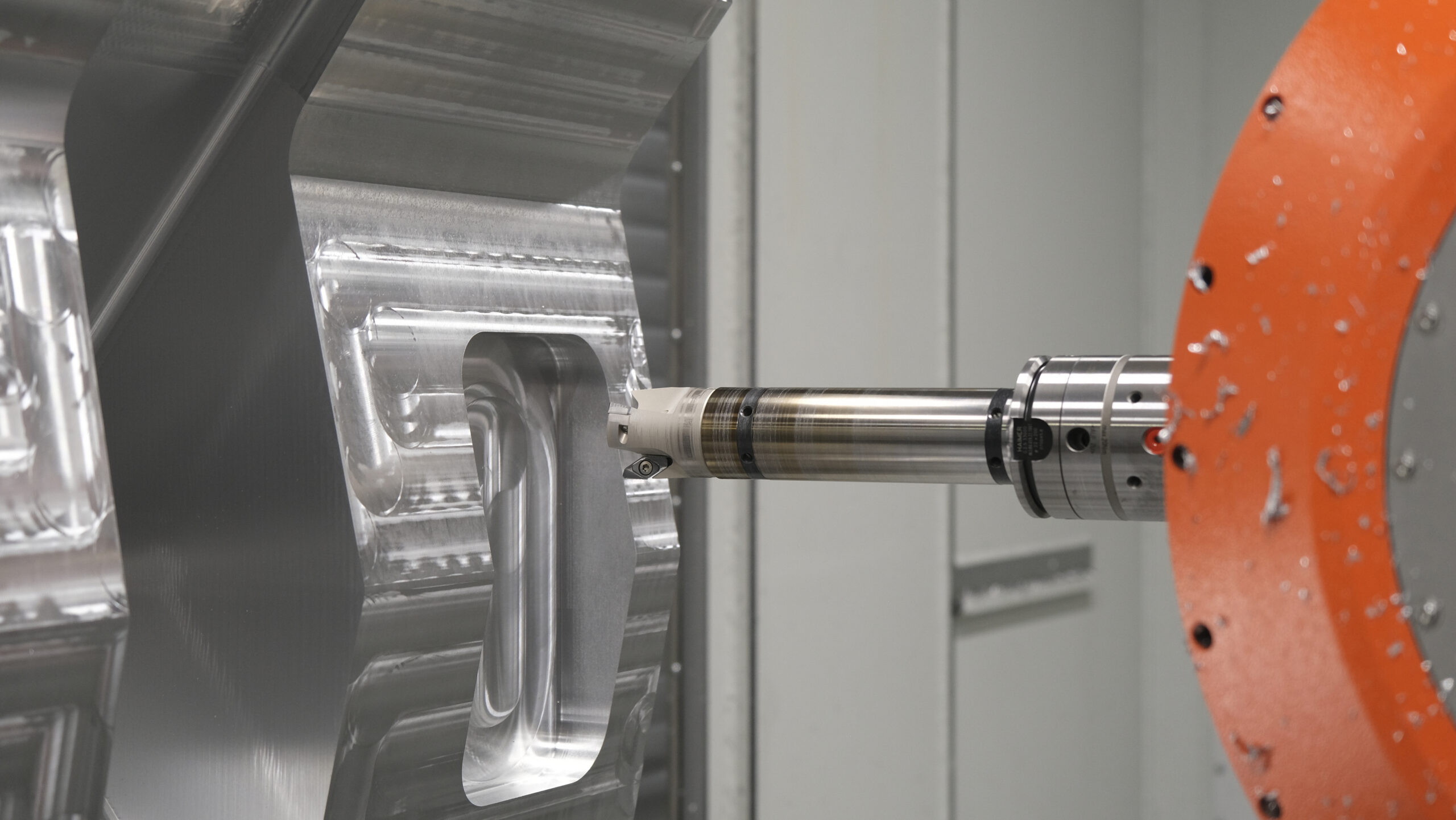
Machine manufacturer bavius technologie conducted a test cut under real conditions to convince a customer that even long overhanging tools run smoothly on the machine with the smaller HSK tool holder. An important part of the test was to get the right tools. With a tool set for roughing and finishing from ISCAR, the test exceeded all expectations.
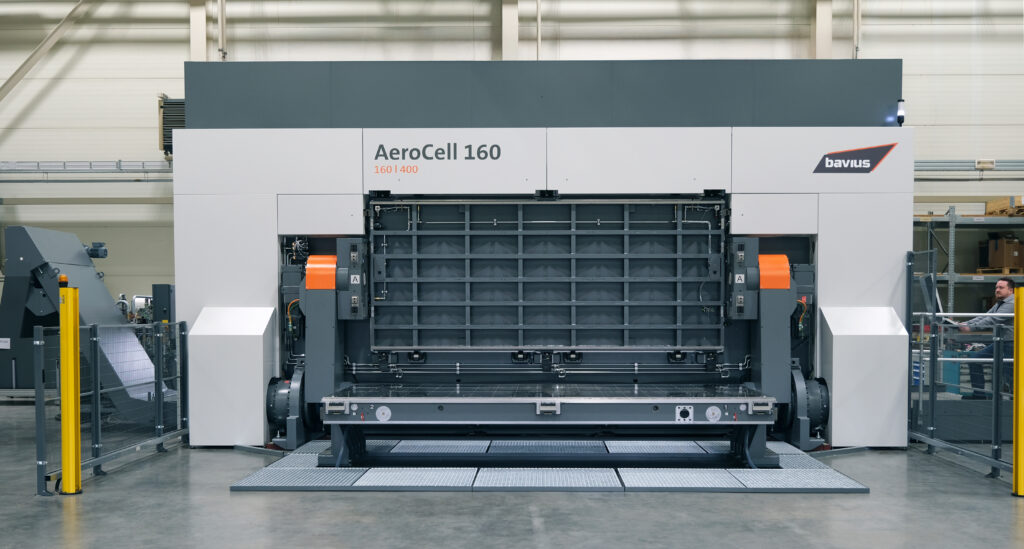
bavius technologie, based in Baienfurt, Germany has been operating since 2017 as an independent, family-owned company with around 120 employees in the development and production of high-speed CNC systems for high-volume aluminum machining. bavius focuses on two product lines: PBZ profile machining centers and HBZ horizontal machining centers with the AeroCell series.
Wanted: dynamic machine
“An American company in the aerospace industry was looking for a system that offered high removal rates, dynamics, and availability while also delivering high machining quality for the production of large aluminum structural components,” explains Dominik Merz, Director of Global Sales | Applications at bavius. “A perfect task for our HBZ AeroCell 160 I 400.” The machine has a high-performance spindle that runs at up to 30,000 revolutions per minute and delivers 140 kilowatts of power in continuous operation (S1 mode). In S6 mode, power outputs of up to 175 kilowatts are available for short periods. “Since the 140 kilowatts are already available at 19,000 revolutions per minute, high power outputs can be achieved even in the medium speed range, which offers a number of advantages,” explains Dominik Merz.
Only the HSK-A63/80 tool holder used as standard by bavius caused concern for the US customer. Based on experience and for stability reasons, he preferred a larger one. However, this would have significantly limited the available machining capacity of the system. “In order to be able to run at 30,000 rpm, the AeroCell 160 is equipped with an HSK 63/80 tool holder, which, thanks to its larger contact surfaces, provides the necessary stability to the tool even with long overhangs,” explains Stefan Diem, application engineer at bavius. “With a HSK100 holder, on the other hand, only 20,000 rpm would have been achievable. That was not an option for bavius at first and would have limited the advantages of the machine.” Dominik Merz adds: “Above all, 70 to 80 percent of the machining of such parts, which often takes several hours, is carried out with short tools. In production, it quickly becomes apparent whether the user can utilize the full speed and full power.”
The bavius team agreed with the customer to conduct a live test run under real conditions at bavius in Baienfurt, Germany to demonstrate that the smaller holder also offers the necessary stability for long tools. The plan was the following: a 170 × 626 millimeter and 260 millimeter deep V-shaped pocket, as typically found in structural components for aviation, was to be cut into a 600 × 780 × 500 millimeter block of EN-AW 7012 (AlZn6Mg2Cu) aluminum- wrought alloy.
Customized solution
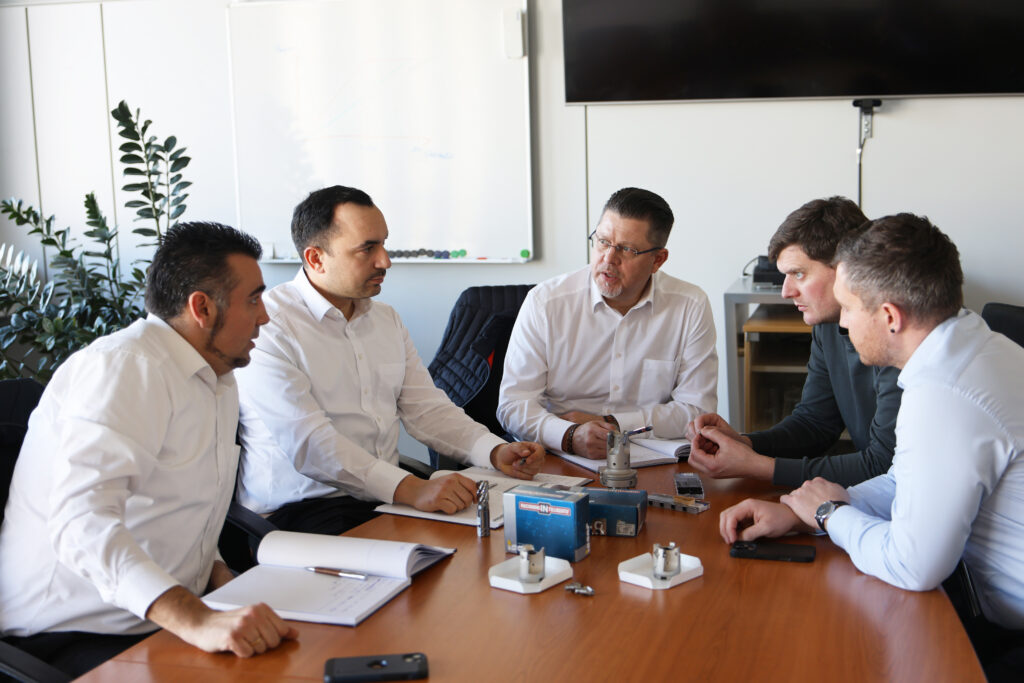
“We contacted our longtime partner ISCAR to put together the optimal tool package for roughing and finishing,” explains Stefan Diem. Michele Piccolantonio, Equipment Projects Consulting and Sales, Calogero La Quatra, Product Specialist Multi Master, Solid Carbide and PCD Tools, and Anton Kress, Product Specialist Milling, were briefed on the task and, together with the bavius team, put together a set precisely tailored to the task and the material.
“Aluminum can generally be machined quickly and easily, but it still has its peculiarities,” says Anton Kress. Highly positive systems with very sharp polished cutting edges are required here to prevent chips from sticking to the cutting edge and surface, ensuring reliable operation. This also results in lower cutting forces during machining. This offers enormous advantages when using long tools and significantly reduces deflection and vibrations.
“Important selection criteria therefore included the use of soft-cutting standard tools that support the machine’s high dynamics, allow high speeds, and run reliably in order to maintain high plant availability,” says Michele Piccolantonio. “In addition, very high removal rates should be possible during roughing – keyword: high-volume machining – and top surface qualities during finishing,” adds Anton Kress.
The result was a tool set with milling cutters from the HELIALU, MegaAlu, and MULTI-MASTER families.
Roughing a large amount of material quickly
HELIALU milling cutters with targeted JHP cooling and a diameter of 50 millimeters were used to remove large quantities of material in a short time. For roughing the surface contour and the first part of the pocket, the milling cutter was designed as a 110-millimeter-long monoblock tool equipped with four indexable inserts with two helical cutting edges. The circumferentially ground, 22-millimeter-long, sharp cutting edges with a highly positive rake angle and polished rake faces cut smoothly and ensure excellent chip flow. “This allowed us to rough at a spindle speed of 25,400 rpm and draw up to 148 kilowatts at the spindle,” says Stefan Diem happily. “At a feed rate of 25,400 millimeters per minute and a cutting depth of 16.5 millimeters, we were able to remove up to 14.5 liters of material per minute.” Bavius used HELIALU face mills in lengths of 157, 207, and 257 millimeters equipped with 14mm long inserts – with speeds of up to 28,000 rpm, a power output of up to 65 kilowatts, and feed rates of up to 16,500 millimeters per minute. “It was really impressive to see how the machine whizzed through the material,” says Dominik Merz.
Using four three-edged MegaAlu solid carbide endmills with a diameter of 25 millimeters and lengths ranging from 5xD to 8xD, bavius reduced the corner radii from R50 and R25 to R12.5 and premachined the pocket to its final depth of 260 millimeters. “We also use the only exceptions to the standard for this. The two endmills in 7xD and 8xD are special tools,” says Calogero La Quatra. “A particular advantage of these three-edged aluminum specialists is that they have an unequal pitch and, thanks to their special cutting geometry, the process is virtually chatter-free even with such high overhangs.”
Top surface quality thanks to MULTI-MASTER milling cutters
However, manufacturing aerospace components is not just about removing large amounts of material quickly. High-quality surfaces are equally important. This makes finishing a crucial process. The test used screw-on solid carbide ball nose and barrel heads from ISCAR’s MULTI-MASTER family with tool lengths between 155 and 293 millimeters. With spindle speeds between 21,000 and 27,000 revolutions per minute, fine, burr-free surfaces with rough depths of 6.5 micrometers were created on the bottom and walls of the pocket within a few minutes.
A three-edged EBA ball-nose cutter with a diameter of 16 millimeters and an 8-millimeter radius was used to finish the bottom of the pocket. Mounted on a 200-millimeter shank, the tool measures 280 millimeters. To finish the larger sides of the pocket, bavius used the barrel-shaped EOBA cutter with a diameter of 16 millimeters, four cutting edges, and a 75 millimeter profile radius on the 200-millimeter shank. “This barrel cutter finishes up to nine times faster than a comparable ball-nose cutter. This is because the radius serves as a mathematical factor and, accordingly, the steps can be increased axially by a multiple,” explains Calogero La Quatra. “And this is achieved at low speeds and independently of cutting parameters.”
Test results exceed expectations
In just three hours, around 70 kilograms of material had been removed and the pocket had been milled into the block reliably and to the required quality. “The combination of a dynamic, powerful system and the right tool ensure shorter processing times and significantly increases productivity,” says Stefan Diem, summarizing the result. “And as predicted, even the long overhanging tools ran absolutely stably and vibration-free with the HSK63/80 holder.” The mechanical engineers took this stability test to the extreme with a 357-millimeter-long HELIALU face mill with a diameter of 50 millimeters: In addition to the V-pocket, they milled another cavity into the aluminum block with a feed rate of 8,100 millimeters per minute and a spindle speed of 18,000 rpm in a process-reliable manner.
“The test run exceeded all expectations. The customer was completely convinced and so enthusiastic that he would have liked to take the machine with him right away,” says Dominik Merz. “Thanks to the combination of our dynamic AeroCell and ISCAR’s innovative tools, we were able to offer him an efficient solution.”